“Alias O. Henry” Available

A few years ago, I decided to try something completely different: a novel, my first. Specifically, it’s historical fiction about the author O. Henry (born William Sidney Porter), who arrived in New York in 1902, after a checkered past (to say the least), and captured the rapidly changing city in such short stories as “The Gift of the Magi,” “The Cop and the Anthem,” and “The Last Leaf.”

The book–Alias O. Henry–will be published on September 16, 2025, by Paul Dry Books, an outstanding firm in Philadelphia that has produced a beautiful book, including this great cover by Ian Koviac.
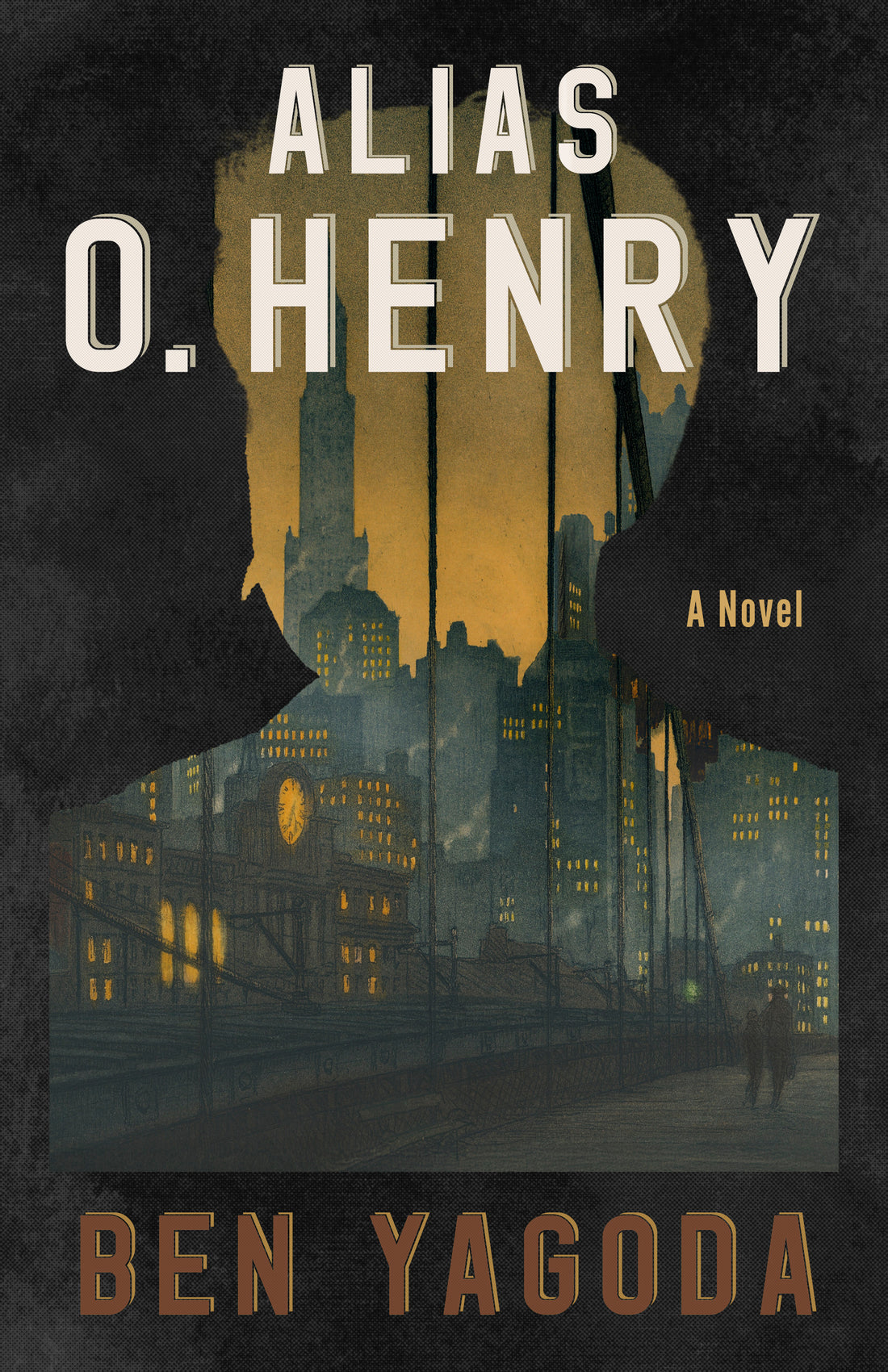
Although the official pub date isn’t for a couple of weeks, it’s currently available direct from the publisher at this link, or from bookshop.org. If you’re an Amazon person, you can pre-order.

The advance notice for the novel has been gratifying in the extreme. Here’s a generous (in both senses of the word) sample:

“[A]n exuberant biographical novel . . . Riffing cleverly on O. Henry’s most cherished stories, Yagoda presents a vivid, witty, and delectable tale of crime and creativity.”Booklist

“The editor of an acclaimed edition of O. Henry’s stories for the Library of America, Yagoda brings his research skills, knowledge of the author, and love of the era to this tale of turn-of-the-century Manhattan, evoking its crowded streets, many vices, and colorful (and often dangerous) citizenry, not to mention the lucrative world of freelance writing at a moment when short stories reigned supreme . . . Gotham might be a perilous place for most, but it’s the perfect spot for a writer in need of material.”
—Kirkus Reviews

“Yagoda delivers a hit with his first novel. . . . Yagoda’s descriptions of the grimy underbelly of a city whose vices are growing as fast as its population provide an authentic backdrop, while his wry humor strikes the perfect balance. O. Henry enthusiasts will get the literary references; however, intimate knowledge of his works isn’t necessary to appreciate Yagoda’s clever irony, which pays homage to the master of the short story without attempting to overshadow him.”
—Library Journal

Alias O. Henry finds Ben Yagoda on the prowl, tracking William Sydney Porter through the grime and glitter of turn-of-the-century New York. Here’s Porter—not yet O. Henry—hustling poolrooms, conning marks, scribbling tales in rented rooms, and ducking the law while chasing the muse. Yagoda, part literary sleuth, part historian with a novelist’s instinct, cracks open the city and the man. The result is pure O. Henry: unexpected, full of heart, and impossible to resist.” —Laurie Gwen Shapiro, author of The Aviator and the Showman: Amelia Earhart, George Putnam, and the Marriage That Made an American Icon 

Alias O. Henry is a delight—a buoyant fictional conjecture about the writer’s hidden life, full of surprise cameos, playful allusions, and other literary and historical Easter eggs. Best of all is Yagoda’s rich portrayal of Ragtime-era New York City, an imaginative evocation as vivid and distinctive as O. Henry’s own.” —Gary Krist, author of Trespassers at the Golden Gate: A True Account of Love, Murder, and Madness in Gilded-Age San Francisco

“Ben Yagoda, the accomplished biographer, literary historian and linguist, has written his first work of fiction, and the result—Alias O. Henry—is a triumph. Blending a fecund imagination with a scholar’s mastery of time and place, he has fashioned a beguiling portrait of America’s most famous short-story writer (born in 1862 as William Sidney Porter) and the hectic metropolis on the Hudson that inspired ‘The Gift of the Magi’ and ‘The Last Leaf.’ With empathy and insight, Yagoda reminds us that New York, New York was the irresistible destination for hustlers and dreamers—including the secretive former pharmacist from North Carolina who became O. Henry—long before Sinatra sang about it.”—David Friedman, author of Wilde in America: Oscar Wilde and the Invention of Modern Celebrity

“Ben Yagoda’s imaginative portrait of William Sydney Porter is a jaunty ride through the bustling streets of New York at the dawn of the modern age—when newspaper men, gumshoes and shopgirls rubbed shoulders with the likes of Thomas Edison, Will Rogers and Bat Masterson. Weaving the facts of Porter’s life together with the themes of his stories and the history of the city, Yagoda has created a novel with a vintage vibe and twisty plot worthy of the name O. Henry.”—Wes Davis, author of American Journey and The Ariadne Objective

“Ben Yagoda brings the writer O. Henry fully to life with the affection and specificity that animate O. Henry’s own stories. It’s all here: early-century perfumes and stenches, music and cacophony, confidences and betrayals. That Yagoda—one of our great chroniclers of language—should find his way so masterfully to this story is no surprise. He delivers us into a Gotham cityscape at a time when new languages erupted in the deadline work of newspaper reporters, sports scribes, cartoonists and movie makers, years before their rugged glories congealed into mass media. Yet he also locates a certain promise for our media-drenched time: all is not lost if there is but a solitary writer using all six senses—the sixth being compassion—to return pen to paper.”
—Michael Tisserand, author of Krazy: George Herriman, a Life in Black and White

“In this masterful and inspired exercise that can only be called researched-based time travel, author Ben Yagoda breathes new life into the rich spirit of O. Henry. Drawing on a library’s worth of vintage material, Yagoda treats us to an accurate, vivid portrait of a quintessentially American character in his own time and place.”
—Kenneth Finkel, professor emeritus, Temple University

“Alias O. Henry transports you into the world of the peripatetic—and sometimes prevaricating—William Sydney Porter. Ben Yagoda weaves two origin stories, Porter’s and the inspirations for his works written as O. Henry. Yagoda takes you back to Porter’s muse, that is, New York City, at the beginning of the 20th century from its gritty underbelly to the colorful characters that populate its noisy streets. This is a novel that entertains and delights.”
—Delia Cabe, author of Storied Bars of New York: Where Literary Luminaries Go to Drink

“Gobsmacked!” On Its Way

I’m happy to announce that I’ve written a book based on my blog Not One-Off Britishisms, which is about British words and phrases that have been adopted in the U.S. It has a publisher (Princeton University Press), a publication date (September 2024 in the U.S., November in the U.K.), a title, and a brilliant cover (designed by Chris Ferrante):

I’m especially pleased by the use of Gill Sans for the subtitle and my name, as that typeface is in itself a Not One-Off Britishism.

Already, the book has received some great endorsements from really distinguished people:

  • “The best exploration of British and American lexical variation and change that I’ve ever read. Or, to put it in the terms of this book: it’s brilliant, gobstoppingly spot-on, streets ahead of anything else.”–David Crystal, author of The Cambridge Encyclopedia of the English Language
  • “One could do worse than to have a lie-in with this valuable and entertaining book, in which Ben Yagoda gets his Britishisms sorted for our benefit. Brilliant, in the best American sense!”—Mary Norris, author of the New York Times bestselling Between You & Me: Confessions of a Comma Queen
  • “Ben Yagoda is one of our most insightful and entertaining commentators on language and culture. In Godsmacked!, he focuses his formidable talents on an original and fascinating story: Britain’s growing influence on U.S. speech. If you’ve ever wondered why you have suddenly started saying things like cheekydodgy, or twee, you’d be bonkers not to devour this wonderful book.”Fred R. Shapiro, editor of The New Yale Book of Quotations
  • “Despite my decades of experience with English on both sides of the Atlantic, and all my academic study of its varieties, Ben Yagoda’s delightful book taught me things I had not yet realized about the British influence on American speech. As anyone acquainted with Yagoda’s writing might expect, his book is both fascinating and fun.”—Geoffrey K. Pullum, University of Edinburgh, coauthor, The Cambridge Grammar of the English Language

As I say, the book won’t be available for several months, but pre-orders are always helpful, as they show the publisher that people are interested. If you’re so inclined, you can pre-order here.

And when events or interviews are scheduled, I will announce them here.

My Gloss on Bateson

The English literary scholar F.W. Bateson (1901-1978) edited a journal called Essays in Criticism. In an editorial from 1966, he discussed the quality of writing he and his colleagues expected from contributors:

To be blunt about it, we want every sentence in every article that we print to be in respectable English. And if I am asked to define what our criteria of stylistic respectability are I will probably have to confess that they boil down to ‘Oxford’ English—by which I mean the kind of prose that Matthew Arnold practised supremely well and that is still written, perhaps from the benefit of his example, by a surprising number of members of his University.

He then posed the reasonable question, “What are the characteristics by which an Oxford prose style can be recognised?”

His answer is the best one-sentence description I know of a certain kind of good writing. It isn’t the only kind, of course. But the qualities Bateson enumerated will be helpful, I think, to any writer. I set them down below, with my own glosses, emendations, and bracketed additions.

“A preference for short sentences diversified by the occasional very long one, [as well as a preference for short words diversified by the occasional long one];  a tone that is relaxed and almost [emphasis added] colloquial; [the absence of unintentional word repetition, awkward phrasing, clichés, flat rhythm, and weak sentence-endings (reading aloud, sentence by sentence, can help a writer achieve a level of attentiveness that will guard against these)]; [the inclination and ability to deploy fresh and apt metaphors; a sense of humor;] a large [capacious] vocabulary that enjoys exploiting the different social and etymological levels of words; above all, an insistence on verbal and logical precision.”

Roger Angell

There is an article of clothing I always associate with the great writer and editor Roger Angell, who died last Friday, at the age of 101. (Just writing about him made me stick in that last, ultra-New Yorker comma.) That article is the sport coat.

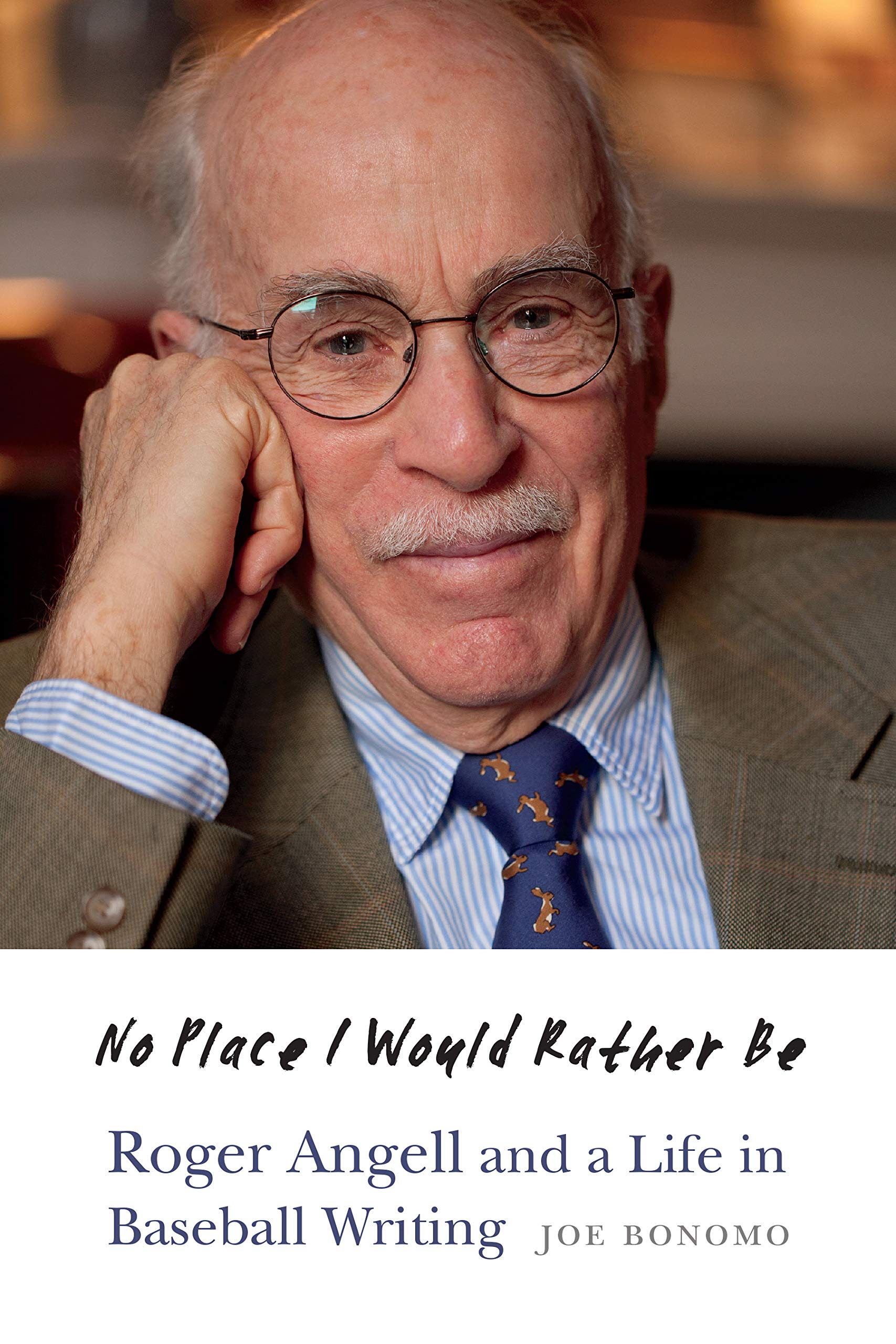
Kind of like the one he is wearing on the cover of Joe Bonomo’s 2019 biography, which I have yet to read but definitely will. I met Angell (pronounced like the heavenly being) on seven or eight occasions, the first in 1978 and the last in 2012, and in my recollection, each time he was wearing a well-tailored coat, with a crisp pastel button-down shirt, solid or striped, and a nicely-matched tie.

Clothes don’t really make the man (in my experience), but in Angell’s case, the jacket was fitting, in both senses of the word. Together with his firm handshake and upright posture, it bespoke a generational sense of, I don’t know, propriety and duty and respect.

As I say, I met Angell in 1978 but encountered him long before, in the pages of the New Yorker. For a kid who liked baseball and (I was slowly coming to realize) good writing, how amazing was it to find someone who combined both! Along with those of Calvin Trillin and Pauline Kael and, later, Woody Allen, John McPhee and Ian Frazier, his pieces gave me a literary model. It’s not that I imagined ever being as good as those writers. It was more like a basketball-loving kid digging on Michael Jordan. The sense of possibility is salutary.

Incidentally, Dwight Garner’sTimes obituary quotes Angell as saying that his baseball reportage started when New Yorker editor William Shawn told him to “go down to spring training” in 1962. When I interviewed Angell for About Town, my 2000 history of the magazine, he told me that he made the pitch, and Shawn — a great editor but not a sports fan — said: “What’s spring training?”

The obit and an appreciation by Times baseball writer Tyler Kepner have some quotes that give the flavor of Angell’s writing:

  • The Boston Red Sox catcher Carlton Fisk came out of his crouch like “an aluminum extension ladder stretching for the house eaves.” The Baltimore Oriole relief pitcher Dick Hall pitched “with an awkward, sidewise motion that suggests a man feeling under his bed for a lost collar stud.” Mr. Angell … described Willie Mays chasing down a ball hit to deep center field as “running so hard and so far that the ball itself seems to stop in the air and wait for him.”
  • On relief pitcher Dan Quisenberry: “His ball in flight suggests the kiddie-ride concession at a country fairgrounds — all swoops and swerves but nothing there to make a mother nervous; if you’re standing close to it, your first response is a smile.”
  • On Philadelphia Phillies second baseman Chase Utley: “Utley, who has slicked-back, Jake Gittes hair, possesses a quick bat and a very short home-run stroke; he looks like a man in an A.T.M. reaching for his cash.” (That was written in 2009, when Angell was 88.)

But the essential Angell passage, to my mind, is the one he wrote about Fisk’s home run in game six of the 1975 World Series for the Boston Red Sox. The broadcaster and jazz writer Tom Reney posted it on Facebook, and I was so happy to be reminded of it:

Fisk, leading off the bottom of the twelfth against Pat Darcy, the eighth Reds pitcher of the night – it was well into morning now, in fact – socked the second pitch up and out, farther and farther into the darkness above the lights, and when it came down at last, reilluminated, it struck the topmost, innermost edge of the screen inside the yellow left-field foul pole and glanced sharply down and bounced on the grass: a fair ball, fair all the way. I was watching the ball, of course, so I missed what everyone on television saw – Fisk waving wildly, weaving and writhing and gyrating along the first-base line, as he wished the ball fair, forced it fair with his entire body. He circled the bases in triumph, in sudden company with several hundred fans, and jumped on home plate with both feet, and John Kiley, the Fenway Park organist, played Handel’s “Hallelujah Chorus,” fortissimo, and then followed with other appropriately exuberant classical selections, and for the second time that evening I suddenly remembered all my old absent and distant Sox-afflicted friends (and all the other Red Sox fans, all over New England), and I thought of them – in Brookline, Mass., and Brooklin, Maine; in Beverly Farms and Mashpee and Presque Isle and North Conway and Damariscotta; in Pomfret, Connecticut, and Pomfret, Vermont; in Wayland and Providence and Revere and Nashua, and in both the Concords and all five Manchesters, and in Raymond, New Hampshire (where Carlton Fisk lives), and Bellows Falls, Vermont (where Carlton Fisk was born), and I saw all of them dancing and shouting and kissing and leaping about like the fans at Fenway – jumping up and down in their bedrooms and kitchens, and in bars and trailers, and even in some boats here and there, I suppose, and on back-country roads (a lone driver getting the news over the radio and blowing his horn over and over, and finally pulling up and getting out and leaping up and down on the cold macadam, yelling into the night), and all of them, for once at least, utterly joyful and believing in that joy – alight with it.

I’m not sure what powers of persuasion were necessary to convince Shawn to allow that final 237-word sentence in the New Yorker, but I’m glad they worked (and no matter that the Sox lost game seven). That first time I met Angell was just three years later. His wife, Carol, was a copy editor at Horizon magazine, where I was doing freelance work, and at a magazine holiday party, there he was, my hero. I walked up to him and gushed about the passage. I don’t remember what exactly he said, only his model of graciousness and (unfeigned) modesty in the face of fanboy fawning.

Angell was and is most famous for his baseball writing, but he had been a fiction editor at the New Yorker since the ’50s. That in itself was remarkable, given that the two most important figures in the magazine’s history (other than Shawn and the founding editor, Harold Ross) were probably Angell’s mother, Katharine White, and his stepfather, E.B. White. Katharine White joined the staff in 1925, just months after its founding, and was a fiction editor until 1960. E.B. White contributed more than 1800 pieces, mostly essays, from 1925 until 1976, and did more than anyone else to establish the magazine’s sensibility and style. So the White-Angell line at the magazine runs from 1925 till 2022.

Taking advantage of our cocktail-party acquaintance, I started sending Angell submissions: not proper short stories, but (supposed) humor pieces. None were accepted, but each time Angell responded sympathetically, with specific and smart comments and suggestions.

The impetus for About Town was a short article in the Times in 1993 noting that the New Yorker was moving its offices to a block away in midtown Manhattan, and in the move was donating a large chunk of its editorial archives to the New York Public Library. I showed up at the NYPL just weeks after the material was opened up to researchers, and was asked to choose which of the 300-some boxes I wanted to look at. Tough call! In the finding aid, I happened to come across the name of the short story writer Ann Beattie, a favorite of mine, and asked to see her file. When I got it, I saw that her first submission was a story called “Blue Eggs,” in 1972. Note that Beattie was an unknown, unpublished college English instructor, and her story came in over the slush pile. A first reader must have been impressed with it, and sent it to Angell. I read the carbon copy (look that up, young ‘uns) of his letter to her:

“These little slices and moments are often surprisingly effective, but the story itself seems to get away from you as it goes along. It seems possible that there is more form than substance her, but perhaps that is unfair. What I most admire is your wit and quickness and self-assurance. I hope you will let me see more of your work,and that you will address your future submissions directly to me.”

Angell rejected thirteen more of Beattie’s stories over the next twenty-two months. Then, in November 1973, she submitted a story called “A Platonic Relationship.” Sitting in the Rare Books and Manuscripts Room, reading Angell’s reply, I found myself getting choked up. He wrote:

Oh, joy …

Yes, we are taking A PLATONIC RELATIONSHIP, and I think this is the best news of the year. Maybe it isn’t the best news for you, but there is nothing that gives me more pleasure … than at last sending an enthusiastic yes to a writer who has persisted through as many rejections and rebuffs as you have. It’s a fine story, I think — original, strong, and true.

At that moment, I knew I would write a book about the New Yorker, and even what type of book it would be. Roger Angell was one of the first people I approached for an interview, and I fruitfully spoke with him two or three times, at length. I am only now surmising that he may have had a hand in something that was crucially important for the book: the blanket permission I got from the magazine to quote not only from its contents but from the correspondence from its staff members — including Ross, Shawn, Mrs. White, William Maxwell, and many more. It was a huge deal, and without those quotes the book would have been immeasurably poorer. I’m guessing that Angell liked the cut of my jib, and helped, with his estimable institutional standing, to get me the okay.

All my other encounters with Angell over the years — in person, over email, or on a stage at the Free Library of Philadelphia, where I interviewed him at a public event in 2006 — were positive as well. The best one of all came in 1993. In 1932, the humor writer Frank Sullivan began publishing an annual poem in the New Yorker‘s Christmas issue called “Greetings, Friends”; it sent holiday greetings, with maximal elegant variation in the phrasing, to as many celebrities and noteworthy as could be squeezed in. Sullivan died in the ’70s and Angell took it over. (Ian Frazier took it over from him in 2000.)

What I found when I opened the December 27, 1993, is something so great that I still have to pinch myself to believe it’s true. Yes — there I was in “Greetings, Friends.” Roger Angell, thanks for that and so much else.

Gaslighting, Again

A couple of days ago, Roxane Gay (@rgay) took to Twitter with a complaint about the new movie “Being the Ricardos”:

“Lucy [Nicole Kidman] says ‘don’t gaslight me’ and it’s so annoying! There is no way she would have said that in the 1950s. How did that get through?”

Others took up the theme, inspiring me to repost my 2017 historical investigation of “gaslight,’ the verb. Here it is, followed by an update.

The American Dialect Society met in January and chose dumpster fire as Word of the Year. The winner in the “Most Useful/Likely to Succeed” category was gaslight, a verb is defined as  to “psychologically manipulate a person into questioning their own sanity.” (Of course linguists would use singular they.)

There was immediate pushback. On the ADS email list, John Baker asked, “What is the rationale for naming ‘gaslight’…? The word has been around for decades. Did it come to some special prominence in 2016?” Arnold Zwicky chimed in: “Over seven decades, in fact. The movie that’s the source of the expression came out in 1944.”

Similarly, when I posted the winners on Facebook, my friend Pat Raccio Hughes commented, “How is that on the list? Isn’t it supposed to be new stuff?” She added that she and her husband had been using it since 1990.

The society addressed this issue in its press release on the voting: “The words or phrases do not have to be brand-new, but they have to be newly prominent or notable in the past year.” So does that apply to gaslight?

Yes, I’d say. The new prominence came from Donald Trump’s habitual tendency to say “X,” and then, at some later date, indignantly declare, “I did not say ‘X.’ In fact, I would never dream of saying ‘X.’” As Ben Zimmer, chair of the ADS’s New Words Committee and language columnist for The Wall Street Journal, pointed out, The New Republic, Salon, CNN, The Texas Observer, and Teen Vogue (“Donald Trump Is Gaslighting America”) all used the metaphor as the basis for articles about Trump.

The New York Times first used the common gerund form, gaslighting, in 1995, in a Maureen Dowd column. But there were only nine additional uses through May of last year. From June 2016 through the end of the year, the Times used gaslighting 10 times, including a Susan Dominus essay called “The Reverse-Gaslighting of Donald Trump,” which riffed on Hillary Clinton’s line in a September debate: “Donald, I know you live in your own reality.”

As so often happens when you get a lot of language observers together, the discussion shifted: from whether gaslight was newly prominent to precisely how old its verb use is. The history begins with Patrick Hamilton’s 1938 play Gas Light (known in the United States as Angel Street). It inspired a 1940 British film and the more famous 1944 American production, directed by George Cukor and starring Ingrid Bergman, Joseph Cotten, and Charles Boyer. (Spoiler alert.) The Boyer character tries to drive the Bergman character (his wife) crazy, notably by insisting that the gaslights in their house did not flicker, when in fact they did.

But there is no verb gaslight in Gaslight. As I noted on the ADS email list, in response to Baker and Zwicky, this use emerged some 20 years later, according to the Oxford English Dictionary. Its first citation is a sentence from a 1965 article in the magazine The Reporter: “Some troubled persons having even gone so far as to charge malicious intent and premeditated ‘gaslighting.’” The quotation marks around the word are a sign that it was a recent coinage.

Jonathan Lighter, editor of The Historical Dictionary of American Slang, responded that he had noted in the book an oral use from 1956, by a 41-year-old woman, revealed to be none other than his mother. Lighter also said he has a strong memory of the verb’s being used in an episode of I Love Lucy the same year. That set Ben Zimmer to work. He posted:

There’s a 1956 I Love Lucy episode called “Lucy Meets Charles Boyer,” in which Ricky conspires with Charles Boyer to make Lucy think that Boyer is merely a lookalike. There are obvious parallels to Gaslight, but I watched the episode here and I didn’t hear anything about “gaslighting.”

Bill Mullins replied: “I vaguely recall an episode of the The Lucy Show [a later Lucille Ball sitcom] in which gaslighting is a plot element.” Mullins went to  Google and and found a web page titled “The Ten Best THE LUCY SHOW Episodes of Season Six” (perhaps proving that there is a web page for every conceivable topic). One of the 10 was “Lucy Gets Mooney Fired,” which aired in November 1967. The web page gives a plot summary and commentary:

Lucy inadvertently gets Mooney [Gale Gordon] fired after she covers up a bank shortage. To convince Cheever [the bank president] to give Mooney his job back, Lucy gives him the Gaslight treatment.

I love how kooky this episode is WITHOUT managing to insult its audience’s intelligence. Taking a cue from Gaslight (1944), Lucy decides to make Cheever think he has gone crazy, so that he’ll agree to rehire Mr. Mooney. The script itself isn’t that funny, but the bits Lucy does to make Cheever flip are great. This is, deservedly, a fan favorite.

The estimable Zimmer wasn’t done. Consulting with Josh Chetwynd, author of Totally Scripted: Idioms, Words, and Quotes From Hollywood to Broadway That Have Changed the English Language, which has an entry on gaslight, he located and watched a 1952 episode of The Burns and Allen Show called “Grace Buying Boat for George.” (It’s a tough job but somebody’s got to do it.) Zimmer wrote, “At 16:20 in the YouTube video, Harry (Fred Clark) says to Gracie, ‘Give him the gaslight treatment!’ and then explains what that means. A bit later you hear George say, ‘So they sold Gracie on the gaslight bit.’”

Still no verb, you’ll notice. Zimmer took care of that a few hours later:

Here’s an example of the verb “gaslight” in “The Grudge Match,” an episode of Gomer Pyle: USMC that aired on 12 Nov. 1965 (antedating OED’s 1969 cite for the verb, as well as the Dec. 1965 cite for the verbal noun).

Duke: You know, you guys, I’m wondering. Maybe if we can’t get through to the sarge we can get through to the chief.

Frankie: How do you mean?…

Duke: The old war on nerves. We’ll gaslight him.

Leading me to muse on the fascinating possibility that the writer of the Reporter piece heard the verb on Gomer Pyle and put it into print just a month later.

But then more detective work was done on the ADS list. Stephen Goranson discovered that an even earlier use of the verb far, in Anthony F.C. Wallace’s 1961 book, Culture and Personality:

It is also popularly believed to be possible to “gaslight” a perfectly healthy person into psychosis by interpreting his own behavior to him as symptomatic of serious mental illness. While “gaslighting” itself may be a mythical crime, there is no question that any social attitude which interprets a given behavior or experience as symptomatic of a generalized incompetence is a powerful creator of shame[….]

(The OED has the quote but credits it to a 1969 reprint.)

In any case, the term was picked up, especially in reference to abusers of spouses, partners, and children, and was commonplace by 1990, when Pat Hughes reports starting to use it. I myself first heard it the year before, when, on assigment for Rolling Stone, I interviewed the 19-year-old Uma Thurman for Rolling Stone, who used it in a context I don’t recall. The word was new to me, and I meant to look it up, but I never got around to it.

Update, December 2021

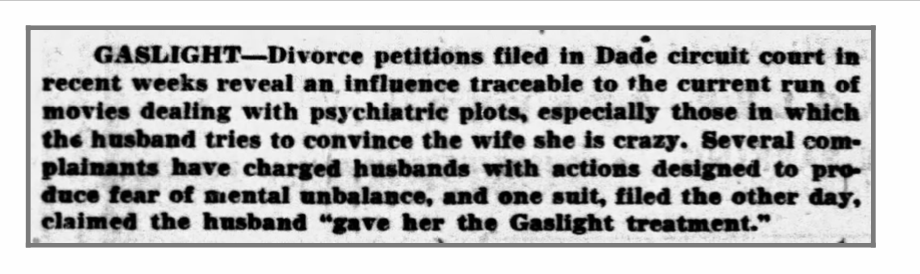
Following the Being the Ricardos kerfuffle, reader Chris Philippo sent me a September 1948 use of “the gaslight treatment” from the Miami News:

He also sent, from Wiktionary, an impressive list of uses of the verb in the early 1960s:

• Jersey Journal [Jersey City, NJ]. February 12, 1962: describing the plot of the episode “Who Is Sylvia” of the television show Surfside 6:
“Sylvia is a beautiful woman whose business-partner husband is ‘gaslighting’ her. (That means he’s trying to drive her crazy.)”
•  Daily Press [Utica, NY]. November 18, 1963: , describing the plot of the episode “The August Teahouse of Quint McHale” of McHale’s Navy:
“[The men of McHale’s Navy] decide to ‘gaslight’ the already befuddled captain, to convince him he is going insane.”
• 1964, in an argument between the characters Jenny and Charley in William Goldman’s novel Boys and Girls Together:
“You’re gaslighting me, for chrissakes.”

R.I.P. Mr. Frishberg

Frishberg in 2011. Photo by Beth Nakamura, The Oregonian

There are two great things about my job. The first is that you can do it in a room in your house. The second is that you get to call up people like Dave Frishberg and, if they’re agreeable, hang out with them for a while.

Frishberg was very kind and generous to me when I contacted him for an interview for my book The B Side. He met me in a bar downtown Portland, Oregon (we both had coffee), and gave me great stuff, including a word-for-word memory of the advice Frank Loesser had given him about lyric writing, sixty years previously:

“Make every statement in the lyrics that you’re using refer to the concept that’s in the title. Don’t leave the listener hanging. Keep the listener interested and surprised, so he can appreciate it and be ready for your next thought. And when you pull off something flashy that you want the listener to remember, to be impressed by, that’s when you put in a riff, a couple of bars. Don’t pile climaxes or punchlines next to each other.”

“Take Back Your Mink”/”Peel Me a Grape.” QED

At the time he was talking to Loesser, in the mid-to-late 1950s, his songwriting was going nowhere and he was making a living as a (superb) piano accompanist to singers like Dick Haymes and Carmen McRae. (His jazz chops were never in doubt.)

He told me: “I tried to write for what I perceived was the market. I ended up writing shit, on purpose. I was trying to sound like this writer or that. A few country songs, a few folk songs–that was big at the time. After two or three years of futility, I abandoned that. I began to write songs as if it were 1937. The music that I liked to play, the music I liked to listen to, was music from the Gershwins, from Porter. I thought to myself, ‘If that’s the stuff you love so much, that’s what you should try to write like.’ Of course, when I said that, I abdicated from the market. But I began to enjoy songwriting more.”

There followed “Devil May Care,” “Do You Miss New York?”, “Quality Time,” “My Attorney Bernie,” “Van Lingle Mungo,” “I’m Hip” (music by Bob Dorough), “You Are There” (music by Johnny Mandel), and, all the obits remind us, “I’m Just a Bill.”

I talked to him by phone a bit after our Portland interview and he pulled out a postcard sent to him by Johnny Mercer, circa 1969 or ’70. He read it aloud in its entirety: “You are my favorite lyric writer at the moment. Boy are you uncommercial!!!” (Frishberg counted out the four exclamation points.)

When the book came out, Frishberg gave it a great blurb. Ever the mensch, he said he would play the piano and maybe recruit his colleague Rebecca Kilgore to sing if I could arrange a book event in Portland. The worst thing about my job are the regrets, and one of my biggest is that I didn’t do whatever it took to make that happen.

Alphabetical Publication Credits

In the bio at right, I note that I’ve written for publications that that start with every letter of the alphabet but two. Here’s a fairly complete list. A * indicates defunct.

A

*American Film

American Heritage

The American Journalism Review

The American Scholar

The American Spectator

American Speech

The Atlantic

*Atlantic City Magazine

B

Baltimore Magazine

Boulevard

*Brill’s Content

*Business Month

C

*Campus Voice

Change

*Channels of Communication

The Chronicle of Higher Education

*The City Paper

Columbia Journalism Review

Connecticut Magazine

D

The Daily Beast

Dissent

*Diversion

E

Esquire

F

*Fame

G

GQ

H

*Horizon

I

*In Health

*Inquirer Magazine

J

Jewish Daily Forward

K

[New York] Knickerbockers Program

L

*Lingua Franca

LitHub

Longreads

*Los Angeles Times Magazine

M

*Mid-Atlantic Country

N

*New Boston Review

*New England Monthly

New Jersey Monthly

*The New Leader

*New York Observer

The New Republic

New York Times Arts and Leisure

New York Times Book Review

New York Times Magazine

New York Times Metropolitan Section

New York Times Op-Ed Page

New York Times Sunday Review

Newsweek

NewYorker.com

*Next

Nieman Storyboard

NPR.org

O

Oklahoma Today

P

Pennsylvania Gazette

Philadelphia Daily News

Philadelphia Inquirer

Philadelphia Magazine

Philadelphia Weekly

*PhillySport

Playboy

Q

QuickandDirtyTips.com/grammar-girl

R

Rolling Stone

S

Salon

*Saturday Review

*Self

Slate

Smithsonian

Sports Illustrated

*Stop Smiling

Swarthmore Bulletin

T

Texas Monthly

*Travel & Leisure

TV Guide

U

USA Today

V

The Village Voice

Vox

W

The Wall Street Journal

The Washington Post Magazine

The Week

The Wilson Quarterly

*Worth

Y

The Yale Alumni Magazine

O. Henry Collected

I’m pleased to announce that the edition of O. Henry short stories I edited for the Library of America has been published and is available for purchase. The early reception has been good, with nice notices in The New Yorker and the Washington Post and an excellent starred review from Kirkus:

A treasure vault of work by a master of the short story form. . . . Yagoda’s well-selected anthology follows O. Henry through all his phases, from Texas bank clerk to fugitive (on account of embezzlement) in Honduras, federal prisoner, and, finally, reasonably successful New Yorker. The volume’s highlight, of course, is Henry’s best-known and much-loved story, ‘The Ransom of Red Chief,’ in which two con men kidnap a ‘boy of ten, with bas-relief freckles, and hair the colour of the cover of the magazine you buy at the news-stand when you want to catch a train,’ who makes their lives a bit of hell on Earth. Most of the stories, ‘Red Chief’ foremost among them, read as if freshly written. . . . The volume provides ample evidence for why one of American literature’s most eminent literary awards should be named for the author. Essential for students of the short story and for fans of Henry’s work.

Reading and evaluating all of O. Henry’s 350-plus works and tracking down every obscure reference for the end notes definitely were time-consuming, but the exercise was always painless and mainly enjoyable. That’s because O. Henry (born William Sidney Porter in 1862) was an excellent craftsman with a lot more tools in his box than the sentimentality and twist ending we know from his most famous story, “The Gift of the Magi.”

I’ll have more to say on this subject in the weeks ahead. So watch this space.

Looks like “looks like me” has arrived

The shirts were the tipping point. After the 2020 election was finally called, they started trickling, then flooding, onto Etsy and other sites. At this point, a Google search for “t shirt” and the rhyming words on the item below yields about 45,000 hits.

Before the phrase was on people’s torsos, some version of it was in their mouths. A lot. To cite a handful of hundreds of published examples, all uttered within a few days of the election:

  • “I’m especially thinking about the little girls of all colors, but in particular, Black and brown girls, because there’s so much power in seeing someone who looks like you.”—ABS News anchor Linsey Davis
  • “So many little girls are waking up across the country saying it is possible. I can be anything I want to be because she looks like me.”—Howard University alumna Wendy Howard
  • “I’m so glad happy to finally have someone in the White House that looks like me.”—Lakhia Day, an official with the Alpha Kappa Alpha sorority

Leslé Honoré adapted one of her poems so that the opening lines read:

Brown girl brown girl

What do you see

I see a Vice President

That looks like me

Then videos of little girls reciting it, like this one, made their way across the internet.


Far from springing up out of nowhere, the “looks like me” trope, in reference to racial identity, has been building momentum for years. In past decades, it was a once-in-a-while thing, as when a Spelman University student told Essence magazine in 1993, “I think this environment is kind of a utopia in terms of race and gender. Everybody here looks like me. We’re all just Black women, and that really gives us a unique experience.”

The phrase picked up speed with the election of Barack Obama in 2008. In fact, he inspired two similarly titled books: The President Looks Like Me & Other Poems, by Tony Medina, and Somebody in the White House Looks Like Me, by Rosetta L. Hopkins. Obama himself memorably invoked the trope in his remarks in 2012 after the killing of Trayvon Martin: “If I had a son, he’d look like Trayvon.”

But as with much else, it was probably Michelle Obama who cemented the phrase in the national consciousness. At the opening of the Whitney Museum in 2015, she said: “You see, there are so many kids in this country who look at places like museums and concert halls and other cultural centers and they think to themselves, well, that’s not a place for me, for someone who looks like me, for someone who comes from my neighborhood.”

At the 2019 Oscar awards, Phil Lord, the director of Spider-Man: Into the Spider-Verse—in which the superhero’s secret identity is teenaged Miles Morales—said, “When we hear that somebody’s kid was watching the movie and turned to them and said, ‘He looks like me,’ or ‘They speak Spanish like us,’ we feel like we already won.”

Later that year, while facing impeachment hearings, Donald Trump tweeted: “All Republicans must remember what they are witnessing here—a lynching.” Rep. Karen Bass responded: “You are comparing a constitutional process to the PREVALENT and SYSTEMATIC brutal torture of people in THIS COUNTRY that looked like me?”  And Rep. Bobby Rush: “Do you know how many people who look like me have been lynched, since the inception of this country, by people who look like you.”

And then came Kamala Harris. A few weeks after the election, she doubled down on—and broadened—the phrase, lauding President-elect Joe Biden for his “commitment to making sure we selected a cabinet that looks like America.” Biden himself invoked the phrase (mangling the syntax a bit) while swearing in staffers on Inauguration Day: “We ran on a promise that this administration would look like America looks.”

As I write, a Google News search of the phrase “looks like me” yields 122 hits in the last week, from an Ohio professor who said, ““As a woman of color myself, specifically South Asian, I cannot express what it means to have someone who looks like me and has had similar life experiences to me in this position” (seven days ago), to a Missouri student’s comment on Harris’s swearing-in: “It felt good because I saw somebody that looks like me and anything is possible” (19 minutes ago). And that of course doesn’t count variations including “looks like them,” “looks like America,” and many more.


“…who looks like me” belongs to a long history of American terms for racial minorities (itself one of the terms). You could almost distill a history of the country from a list of them: colored, Negro, black, African-American, people of color, black and brown people, Black, BIPOC. And those are only the printable ones. Especially for people who are part of the racial majority, as I am, all the terms are problematic, or at least complicated and not-quite-adequate, in ways that don’t need to be rehearsed here.  

And maybe the most appealing thing about “looks like me” is that it’s not problematic. In fact, it’s immune to the usual carping and criticism—it’s pretty much indisputable.

I’ve referred to “looks like me” and its variations as a trope, in other words, a figure of speech. This particular figure is a form of synecdoche, or the part standing for the whole, as in saying “the postal worker is having a tough year,” when you mean all postal workers. This terminology comes from literary criticism, which suggests another element of the power of “looks like me”: it’s poetry, not a prosaic and reductive label. It powerfully and economically particularizes a clunkier word, “representation.” Good poetry makes us see what we perhaps hadn’t seen before, and so it is here. 

A final attribute of the phrase is that it makes a rather brilliantly concise statement against racial essentialism. That is, it implicitly argues that our differences are a matter of looks, appearances, not something ingrained.

The only potential pitfall I see in “looks like me” is overuse. That wasn’t a worry in the nouns and adjectives that came before, but figures of speech can become cliches at warp speed (to use a cliché). So it might make sense to go easy on using “looks like me.” But maybe that isn’t for someone who looks like me to say.

Journalism’s Greatest Hits

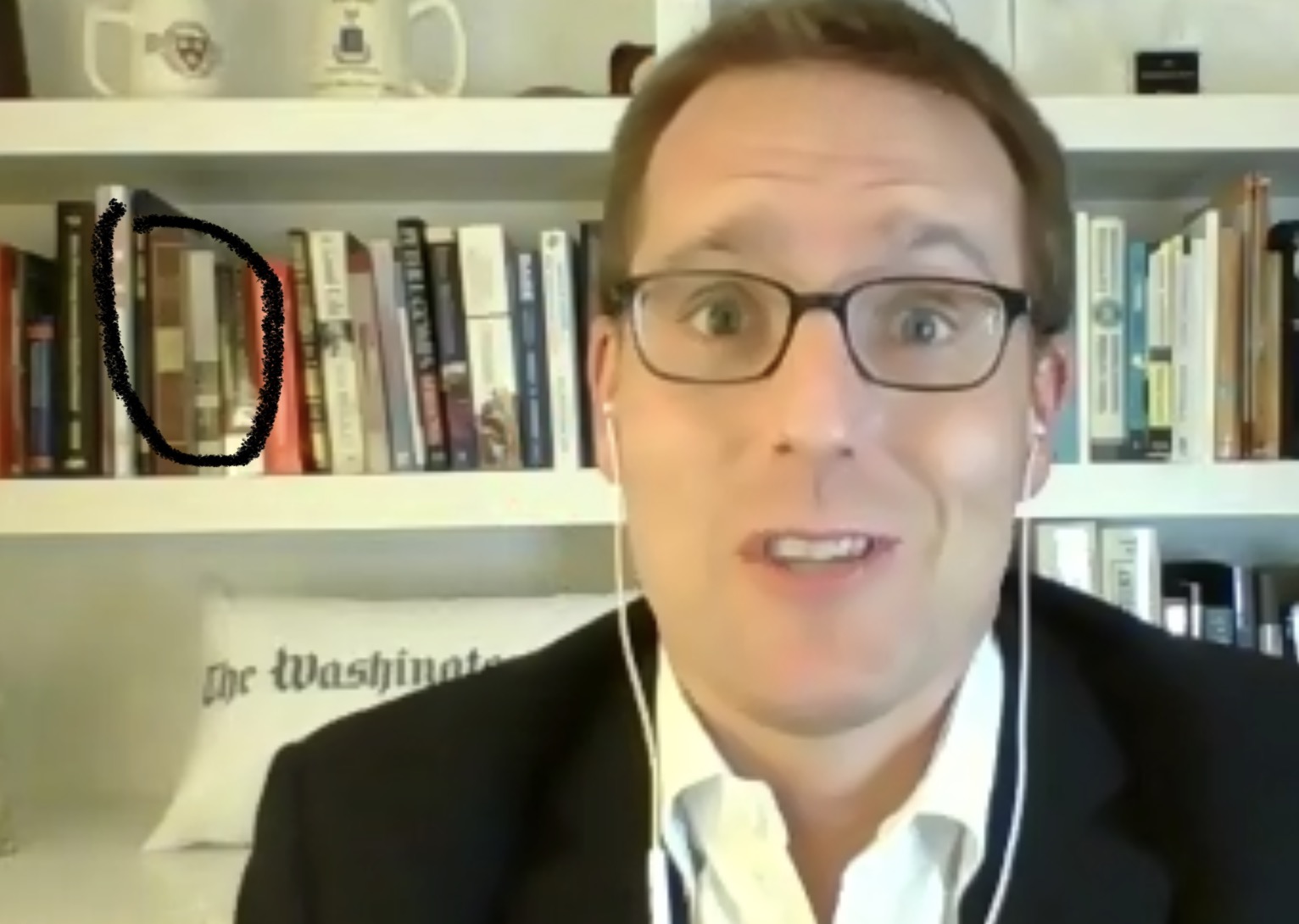
Note circled book, with gold rectangle on the spine, on David Fahrenthold’s shelf.

Twenty years ago, I was honored to be asked by the NYU Journalism School to be a judge for the selection of the greatest works of journalism of the twentieth century. They asked me again ten years ago to help choose the best journalism of the first decade of the 2000s, and again some months back for the years 2010-2019.

The way it worked was that all the judges — comprising the NYU faculty, plus Madeleine Blais, Leon Dash, Adrian Nicole LeBlanc, Wesley Lowery, Greil Marcus, Nilay Patel, Dorothy Rabinowitz, Dan Rather, Frank Rich, David Remnick, Walter Shapiro, Sree Sreenivasan, Sarah Stillman, and yours truly — were asked to submit nominations. Then the full list of 122 nominees was sent out to everyone, and we were to vote for our top ten, in order.

My ballot, including the way I ordered my votes, was admittedly strategic. That is I put a couple of selections in high places not because I could or would make an air-tight case that they were the third and fourth best pieces of journalism of the decade, but because I thought they were absolutely great and they hadn’t quite gotten the recognition they deserved. Conversely, I left out a couple of works because I knew they would (deservedly) get a whole lotta love from the other judges.

Beyond that, I valued works that:

*Afflicted the comfortable.

*(Even better) Comforted the afflicted.

*Displayed disciplined, brave and indefatigable feats of reporting.

*Were stylistically excellent or innovative.

*Moved the national conversation.

*Represented work by a person or organization that had been doing great work for a long time and I felt deserved this level of recognition. (You could call this the John Wayne Oscar phenomenon.)

*I was a bit of a hard-ass on definition of journalism, meaning that I sometimes looked askance at works that seemed to belong more to memoir, essay, or history.

Six of the works on my ballot did not make the top ten. So I will list the six here, in alphabetical order, with descriptions provided by the NYU folks, which I’ll in some cases add my two cents to. And then I’ll give the works that did make it.

The six I voted for:

Matthew Desmond, Evicted: Poverty and Profit in the American City. “An amazing work of immersion journalism.” “Gripping … offers not only a close-up examination of its subjects lives but a meta-analysis of the larger problem.” “The reader understands profiteering from the ground up.”

One thing that excited me about Desmond’s book was the way he landed it on the precise intersection between journalism and ethnography (with a good dollop of public-policy thrown in).

Glenn Greenwald, Barton Gellman, with Laura Poitras and Ewen MacAskill, Revelations of NSA domestic surveillance based on documents from Edward Snowden, The Guardian US, Washington Post. “Changed the world.”

Glenn Kessler and Fact Checker Team, Database of Donald Trump’s false or misleading statements, Washington Post. “A rigorously reported and continually updated list of false statements by the president, numbering more than 19,000 by June 2020. The project is a sterling example of what journalists should do — holding the powerful accountable by using reporting and facts.”

As of July 9: 20,055.

N.R. Kleinfield,The Lonely Death of George Bell,” New York Times. “A detailed examination of what happens after the death of an obscure hoarder — followed by an account of the man’s life that lifts him out of obscurity. Kleinfield’s article represents the pinnacle of narrative feature writing — scrupulously reported, ingeniously structured, and written with clear-eyed empathy.”

I think I actually wrote that, so I’ll add only that the fact that “Sonny” Kleinfield never won a Pulitzer for feature writing is a scandal and a travesty.

Ira Glass, Julie Snyder, Ben Calhoun, Alex Kotlowitz, Linda Lutton and Robyn Semien,Harper High School,” This American Life. “At Harper High School in Chicago, twenty-nine current or recent students were shot in the span of a single year. Learning of this staggering statistic, This American Life embedded three reporters at the school for five months” — Peabody Awards website.

This was an admirable package–but I wanted to recognize “This American Life” because Ira Glass’s now venerable program really did create a great and new form without which it would be hard to imagine “Serial” and just about any other worthwhile narrative journalism podcast that’s not just one or two people sitting around talking.

Frederick Wiseman, In Jackson Heights. “From-the-ground-up portrait of a Queens neighborhood in transition, from the dean of American documentarians. Wiseman has been doing amazing work for more than half a century.”

In Jackson Heights is a great piece of work, with the rigor, indelible characters, intermittent exhilaration and occasional frustration (10-minute dialogues in Spanish with no subtitles) one expects in Wiseman, but I voted for it in recognition of his amazing body of work.

And here’s the NYU top ten:

#1

Ta-Nehisi Coates, The Case for Reparations, The Atlantic.

“Beautifully written, meticulously reported, highly persuasive …” “The most powerful essay of its time.” “Ground breaking.” “It influenced the public conversation so much that it became a necessary topic in the presidential debate.”

#2

Isabel Wilkerson, The Warmth of Other Suns: The Epic Story of America’s Great Migration.

“It’s a masterwork by one of our greatest writers and most diligent reporters. Exquisitely written as it is researched, embracing breadth and detail alike, essential reading to understand America.” “A masterpiece of narrative nonfiction.”

#3

Jodi Kantor and Megan Twohey, She Said: Breaking the Sexual Harassment Story That Helped Ignite a Movement. Based on their reporting for the New York Times.

“A chronicle of the #MeToo era.” “A pitch-perfect primer on how to take a hot-button-chasing by-the-minutes breaking story and investigate it with the best and most honorable journalistic practices.” “This is one of the defining issues of our times, one whose impact will be felt for a long time.”

#4

Katherine Boo, Behind the Beautiful Forevers.

“Unbelievably well written and well reported portrait of a slum in Mumbai.” “Vividly reports on the life of this slum’s inhabitants.”

#5

Michelle Alexander, The New Jim Crow: Mass Incarceration in the Age of Colorblindness.

“The book demonstrates the ways in which the War on Drugs, and its resulting incarceration policies and processes, operate against people of color in the same way as Jim Crow. Powerful on its own terms and crucial as an engine toward transforming the criminality of our ‘justice’ system.”

#6

Julie K Brown, “How a Future Trump Cabinet Member Gave a Serial Sex Abuser the Deal of a Lifetime,” Miami Herald.

“Investigative journalist for The Miami Herald, examines a secret plea deal that helped Jeffrey Epstein evade federal charges related to sexual abuse.” “Brown essentially picked up a cold case; without her reporting, Epstein’s crimes and prosecutors’ dereliction would not be known.” “Great investigative reporting.” “Documenting the abuses of Jeffrey Epstein when virtually everyone else had dropped the story. “What makes this particularly compelling for me is that Brown did the reporting amid the economic collapse of a great regional paper.” “A remarkable effort to empower victims.”

#7

Sheri Fink, Five Days At Memorial: Life and Death in a Storm-Ravaged Hospital.

“In the aftermath of Hurricane Katrina. This is narrative medical journalism at its finest: compelling, compassionate, and unsettling.”

#8

Nikole Hannah-Jones, Matthew Desmond, Jeneen Interlandi, Kevin M. Kruse, Jamelle Bouie, Linda Villarosa, Wesley Morris, Khalil Gibran Muhammad, Bryan Stevenson, Trymaine Lee, Djeneba Aduayom, Nikita Stewart, Mary Elliott, Jazmine Hughes, The 1619 Project, New York Times Magazine.

“Explores the beginning of American slavery and reframes the country’s history by placing the consequences of slavery and the contributions of black Americans at the very center of our national narrative.” “A definitive work of opinion journalism examining the lingering role of slavery in American society.”

#9

David A. Fahrenthold, Series of articles demonstrating that most of candidate Donald Trump’s claimed charitable giving was bogus, Washington Post.

“By contacting hundreds of charities — interactions recorded on what became a well-known legal pad — Fahrenthold proved that Trump had never given what he claimed to have given or much at all, despite, in one instance, having sat on the stage as if he had.”

#10

Staff of the Washington Post, Police shootings database 2015 to present.

“The definitive journalistic exploration and documentation of fatal police shootings in America. In a decade defined, in part, by the emergence of Black Lives Matter, this Washington Post project set a new standard for real-time, data journalism and was a vital resource during a still-raging national debate.” “In the wake of Ferguson, newsrooms across the country took up admirable data reporting efforts to fill the longstanding gaps in existing federal data on police use of force. This project stands out both in its comprehensiveness and sustained dedication.

NYU put together a pretty impressive (all things considered) Zoom presentation on the night of the announcements, with almost all the winners on hand to offer appreciation for the honor and heartfelt words about what their projects meant to them.

The photo at the top of the post is a screengrab of David Fahrenthold’s remarks. I was moved to grab it because on his bookshelf (circled in black), I spotted a copy of The Art of Fact: A Historical Anthology of Literary Journalism, edited by Kevin Kerrane and me.